

Functional Movement & Myofascial Rehabilitation
Move Better. Feel Stronger. Live Freely.
Movement can be like medicine — but only when it's right for your body. At Free to Move we combine myofascial therapy, movement assessment and functional movement to help you move with greater confidence, reduce pain and build strength for everyday life.
30 Marquis St, Hammond Park WA 6164 · within Ascension Chiropractic
The practice
Understand how your body moves before deciding how to treat it.
I work with people experiencing pain, stiffness, injury, hypermobility or chronic conditions — or simply bodies that no longer move the way they once did. Some arrive after years of trying everything else; others just want to finally understand what their body is doing.
Every person is different, which is why treatment is never one-size-fits-all. My goal isn't simply to help you feel better after a session — it's to help you move better for life.
Caring for people is at the heart of what I do — I won't just chase your symptoms; I'll gently keep looking until we find the true root cause, so your body can finally move freely again.
More about me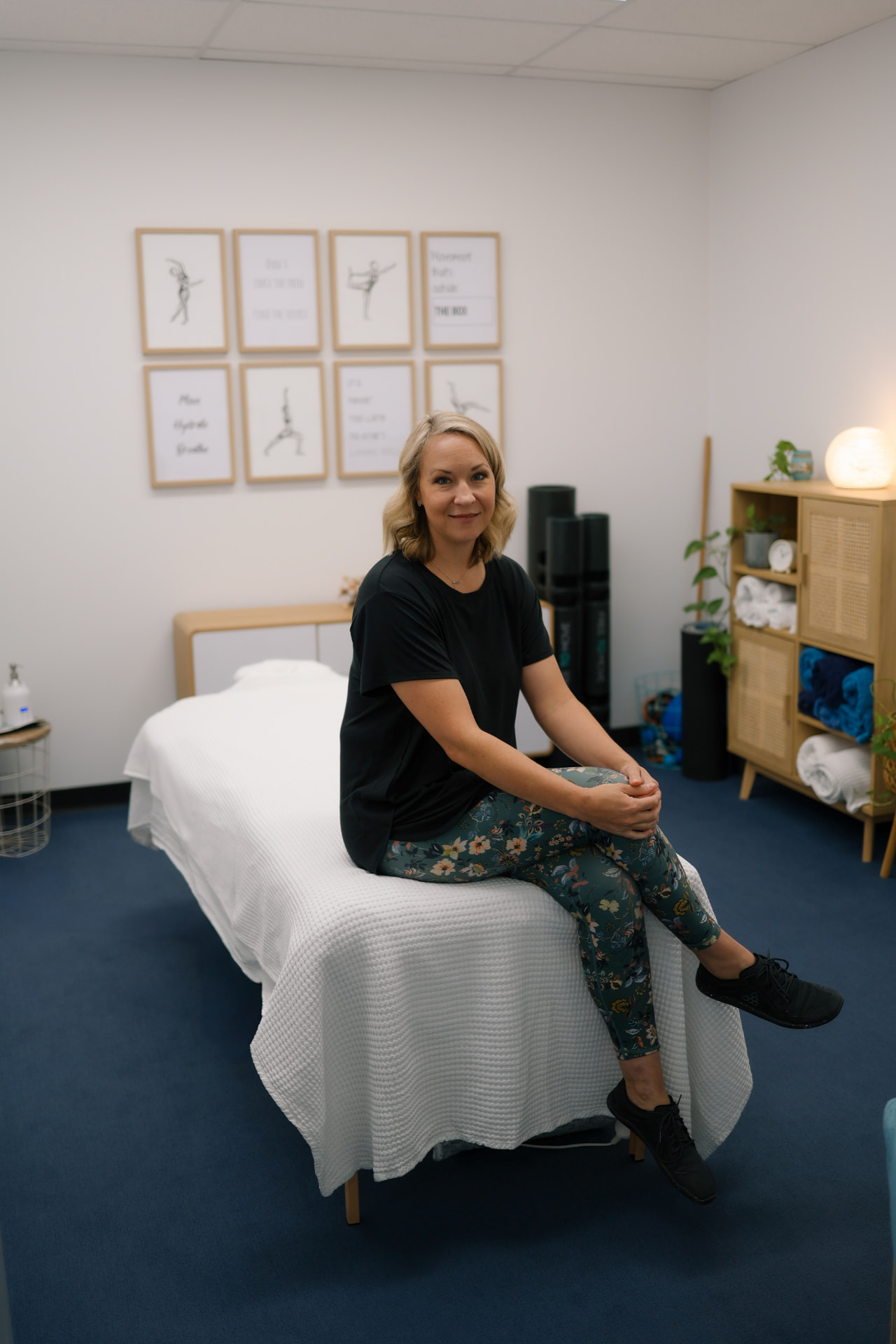
Sound familiar?
Ever wondered why your body keeps falling back into the same old pattern?
Most pain doesn't arrive overnight. It whispers, settles, fades, then returns. Here's what your body might be trying to tell you.
Pain that settles, then comes back
Because the real driver was never addressed — only the symptom.
Stiffness that stretching never quite reaches
The restriction is rarely where you feel it. It's usually deeper, or further away.
An old injury that still changes how you move
Your body adapted around it years ago — and never stopped compensating.
Hypermobility: lots of range, not enough control
More flexibility isn't always the answer. Sometimes the missing piece is stability.
Told to 'just strengthen it', and it didn't help
Strength without context can miss the point. The right muscle has to fire at the right time.
You want to keep doing what you love
But your body keeps sending invoices the next day — and the cost is adding up.
What is fascia?
Fascia is like the fine white webbing inside an orange. It surrounds the whole fruit, separates each segment, and continues down around the individual little juice sacs. In the same way, fascia is not just an outer wrapping — it is a continuous, three-dimensional web that surrounds and connects your muscles, bones, nerves and organs at every level. When it gets tight, dehydrated or stuck in one area, that tension pulls through the rest of the web — which is why the sore spot is rarely the real problem.
Why fascia matters
For a long time, fascia was thought of as just wrapping material — the stuff that surrounded muscles, organs and nerves. In anatomy classes, it was often cut away to show what was underneath.
Over time, research began to show that fascia is much more than passive packaging. It forms a continuous connective-tissue network throughout the body, capable of transmitting and responding to mechanical forces and interacting with muscles, nerves and other tissues.
Modern research has increased interest in fascia's role in movement, force transmission, proprioception and pain, although the science continues to evolve.
Today, fascia is increasingly considered as part of an integrated movement system rather than something that can be understood only by looking at individual muscles in isolation. This whole-body perspective is central to the Free to Move approach — we look beyond where you feel restriction and explore how your body moves and connects as a whole.

What happens when fascia changes
Fascia isn't just a wrapping. It is alive with nerve endings, fluid pathways and movement memory. When it gets sticky or tight, it can affect how you feel, move and recover in ways that are easy to miss.
Nerve endings can get stuck
Fascia is packed with sensory nerve endings. When it becomes thick or glued down, it can trap or irritate nearby nerves, causing shooting pain, tingling, burning, numbness or a pinching feeling that often doesn't show up on scans.
Lymphatic flow can be obstructed
Fascia forms the channels through which lymphatic fluid drains. Tight, dehydrated fascia can narrow those channels, slowing the removal of waste and swelling. That's why releasing fascia can help with heaviness, puffiness and sluggish recovery.
Adhesions change how you move
When fascia is injured, inflamed or held in one position too long, layers can stick together and form adhesions. Your body then adapts — limping, hiking a hip, tightening a shoulder or changing how you sit. Over time, those adaptations become new pain patterns.

Watch and learn
A short explainer to help you understand fascia and why it matters for your body.
Fascia in 3 minutes
The Free to Move Method
Everything starts with the appraisal
The appraisal isn't step one of a program — it's the foundation the plan is built on. You might need hands-on therapy. You might need movement work. You might need all of it. You genuinely can't know until your body has been properly assessed.
The Myofascial Appraisal
90 minutes of movement-based fascial testing to identify restriction, compensation and reduced control.
Book an AppraisalFrom that, your plan
Massage Therapy
Hands-on treatment tailored to what your body needs on the day.
Myofascial Movement Sessions
1:1 work bridging treatment and movement — mobility, stability, control.
Myofascial Movement Classes
Small-group outdoor strength for everyday life, adapted to your level.
After your appraisal we will work together to determine the next step in your wellbeing journey.
After your appraisal
Where you go next
You don't have to choose between these. After the appraisal, Liandi tells you which combination you need — hands-on therapy, movement, group classes, training, or a mix.
Hands-on treatment
Massage Therapy
A blend of therapeutic massage and myofascial bodywork, tailored to what your body needs on the day.
Detox & fluid balance
Lymphatic Reset™
A specialised treatment stimulating the seven major lymph node sites to support detox, reduce swelling and restore energy.
1:1 mobility
Myofascial Movement Sessions
Guided mobility, stability and strength work so your body can hold and use the range we free up.
Small outdoor groups
Group Sessions
Outdoor Myofascial Movement Classes combining functional movement, mobility and strength in Hammond Park parks — Tue 9am, Sat 6am, $18 pay-as-you-go.
Individual training
1:1 Personal Training
Individual training built entirely around you — functional strength, movement quality and confidence, one-to-one.
Gentle individual support
Supported Movement Sessions
Gentle, individual movement support for older adults and people living with neurological or health conditions to stay mobile, capable and confident.
Hammond Park, WA
Where to find us
We're based within Ascension Chiropractic in Hammond Park, with easy street parking and step-free access.